
The Real AI Debt Nobody's Talking About
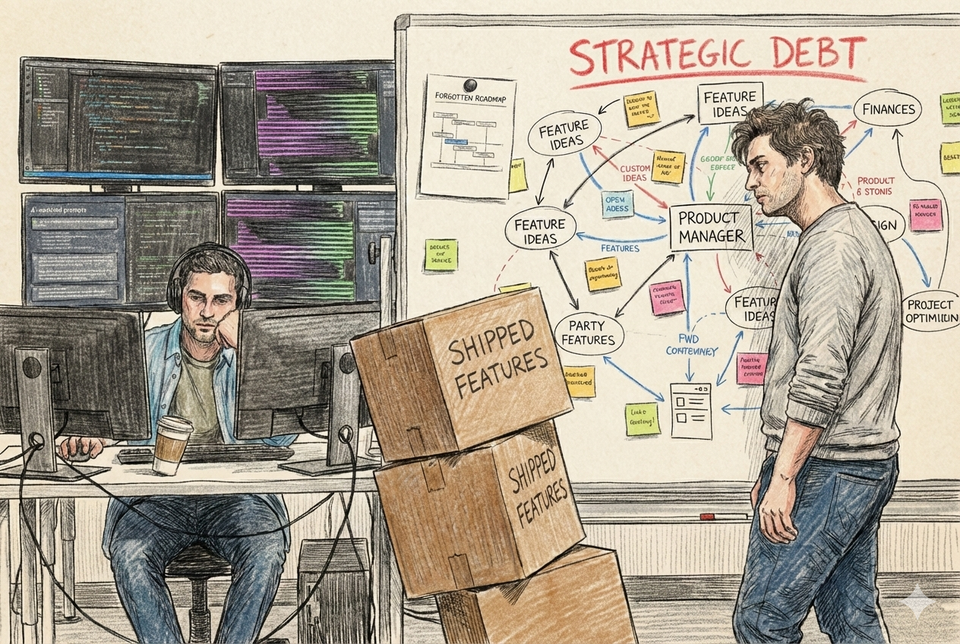
Technical debt doesn't kill most companies
Look at the startup graveyard. You won't find it filled with companies that had messy codebases. You'll find companies that built beautifully architected solutions to problems nobody had. Companies that spent months perfecting infrastructure while competitors shipped something ugly that customers actually wanted.
Technical debt is a slow burn. It makes engineers anxious and slows development. But companies limp along with horrifying technical debt for years, sometimes decades.
Try limping along without customers.
"But technical debt slows iteration!" True, eventually. But strategic debt stops iteration immediately. Build the wrong thing and there's nothing worth iterating on.
Here's the irony: unfocused products create more technical debt, not less. Every feature you shouldn't have built is code you now have to maintain.
Strategic debt is the real killer
When a feature that used to take a few weeks can now ship in a few days, the question of "should we build this at all?" becomes exponentially more important.
Call it strategic debt: the accumulated cost of building features without validating whether they should exist.
Before AI tooling, development speed was a natural brake. When a feature took three months, there were multiple opportunities to question it: design reviews, sprint planning, stakeholder check-ins. The friction was frustrating, but it forced deliberation.
That brake is gone.
A team can conceive of a feature Monday and ship it Wednesday. The speed is intoxicating. It's also dangerous. Every feature you ship is surface area. Something to maintain, something to document, something that creates user expectations, something that complicates everything that comes after.
When you could only build one thing per quarter, you had to choose carefully. When you can build ten things per quarter, the discipline of choosing becomes harder, not easier. The temptation to "just build it and see" becomes overwhelming.
Strategic debt compounds. Your product becomes a sprawling collection of half-validated experiments. Your roadmap turns reactive. Users lose track of what your product actually does.
The iteration fallacy
The obvious counter: "If we can build faster, we can also correct faster. Ship something, learn, iterate."
There's truth here. Intercom talks about starting with a cupcake: ship something small, validate it, then expand.
But shipped features create expectations. Users build workflows around them. They tell colleagues. They integrate it into their processes. Removing or changing that feature now costs you trust, not just engineering time.
Worse, every feature shapes perception. Ship enough unfocused features and users forget what your product actually does. Positioning confusion is harder to fix than buggy code.
Fast iteration doesn't eliminate the need for strategic clarity. It makes clarity more important: you're making more decisions, faster, with less time to think about each one.
What actually matters
If strategic debt is the real risk, how do you manage it?
Validate before you build, even when building is cheap. The fact that you can build something in a day doesn't mean you should skip asking whether to build it. Spend the time you saved on understanding the problem you're trying to solve better.
Kill features faster. The flip side of building quickly is removing things quickly. Treat every feature as provisional until it proves value. Make sunsetting routine, not exceptional.
Maintain strategic focus. Decide what your product is for. Say no to things that don't fit, even when they'd be easy to build. "We could" is not "we should."
Accept imperfect code, reject unfocused products. AI-generated code won't be perfect. Fine. What's not fine is a product sprawling in every direction because you never had to choose.
The companies that emerge from this AI powered speed run won't have the cleanest codebases. They'll be the ones who maintained strategic clarity while everyone else was shipping features as fast as they could think of them.